Converging Perspectives: Human Experience, Digital Innovation, and Professional Pathways Toward Sustainable Built Environments
DOI:
https://doi.org/10.66408/abc2.2026.34Keywords:
Sustainable construction, Human-centred design, Digital transformation, Professional practice, Embodied carbon, Socio-technical systemsAbstract
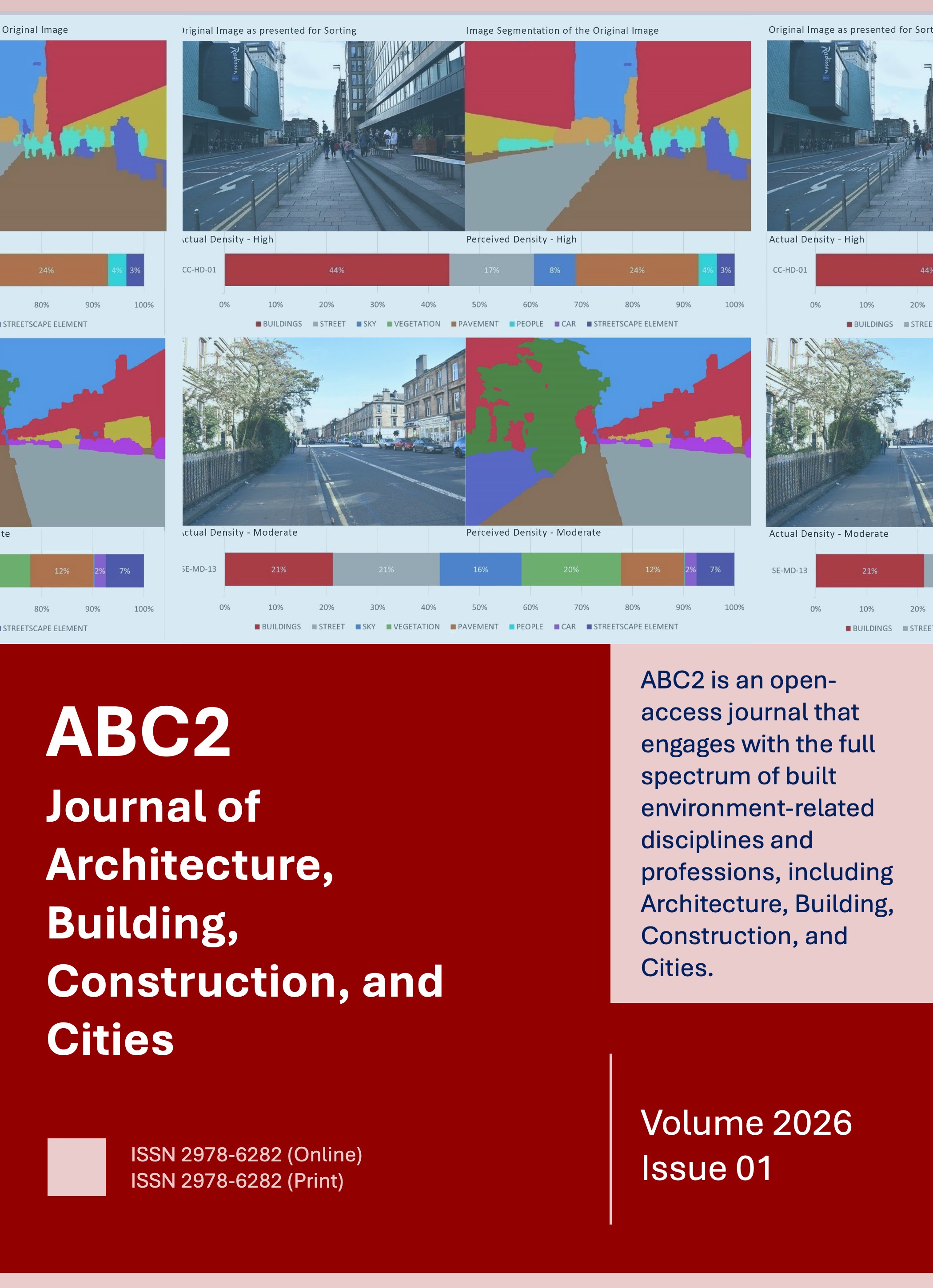
This editorial introduces 2026 – 01 issue of ABC2, offering five research contributions that collectively offer insights for understanding sustainable transitions in architecture, building, construction, and cities. The issue bridges human-centered approaches with technological innovation, examining how cognitive science informs urban density management, how fuzzy-based methods assess green building performance, what barriers constrain 3D printing adoption in developing economies, how theory-informed frameworks enable construction exoskeleton implementation, and how quantity surveying practice evolves to incorporate embodied carbon accounting. Drawing on theoretical frameworks from Salama's work on perceptual approaches and transformative pedagogy, alongside Rahimian's research on digital construction transformation and socio-technical innovation systems, the editorial argues that sustainable futures emerge through convergence rather than technical determinism alone. Seven cross-cutting themes are identified, including perception-performance relationships, socio-technical innovation pathways, professional role evolution, evaluation-based improvement, contextual appropriateness, workforce-centered approaches, and interdisciplinary synthesis. The contributions demonstrate that innovation becomes embedded in practice when organisational capacity, workforce competencies, institutional frameworks, and user acceptance align with technical capabilities. This integrative perspective positions ABC2 to support scholarship that refuses artificial boundaries between disciplines, between theory and practice, between technological possibility and human experience, and ultimately advancing built environments that serve human flourishing and ecological integrity.
Downloads
Published
Issue
Section
How to Cite
License
Copyright (c) 2026 Ashraf M. Salama, Farzad Rahimian

This work is licensed under a Creative Commons Attribution 4.0 International License.