A Cognitive Science Framework for Urban Density Management: Visual Field Thresholds and Infrastructure Moderators
DOI:
https://doi.org/10.66408/abc2.2026.13Keywords:
Density perception, Visual cognition, Environmental quality elements, Cognitive thresholds, Sustainable developmentAbstract
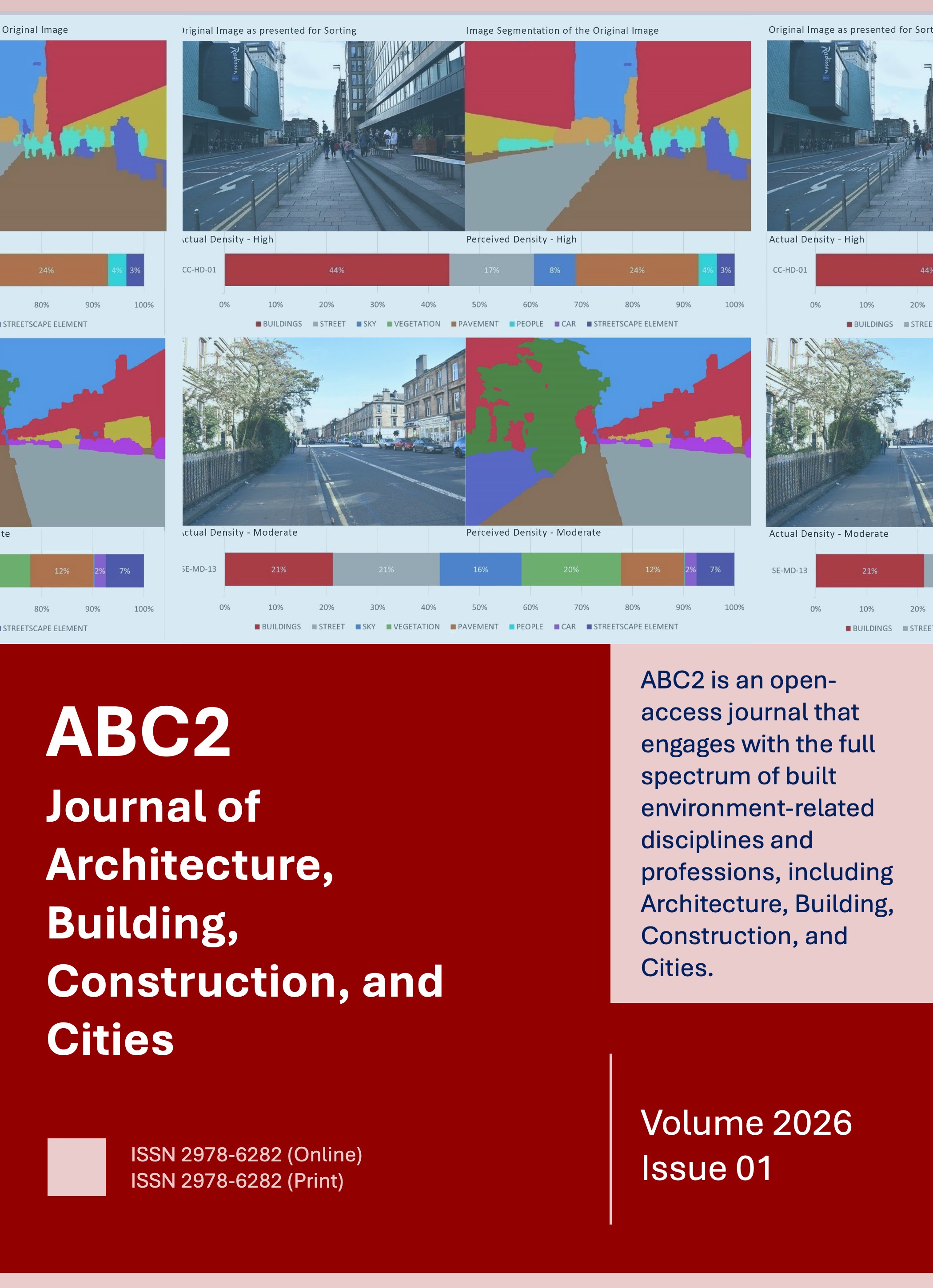
Urban planning's reliance on objective density metrics systematically fails to predict community responses to development proposals. This research demonstrates that density perception operates through cognitive mechanisms analogous to visual perception, governed by measurable thresholds and systematic mediation effects. Through integrated analysis employing Image Segmentation, Situation Judgement Tasks, and Multiple Sorting Tasks with 163 Glasgow residents, the study identifies visual field thresholds where building coverage exceeding 44% of the visual field triggers high-density perception universally, while sky visibility below 10% induces crowding responses regardless of objective measures. Infrastructure quality operates multiplicatively rather than additively, with vegetation presence, pedestrian activity, and mixed-use development creating compound effects that increase acceptable density capacity by 60%. Statistical validation reveals perfect correlations (r = ±1.000, p < 0.001) between visual components and perception classifications, indicating lawful cognitive relationships rather than preference variation. These findings establish that density perception is governed by systematic cognitive principles, enabling precise design specifications through a predictive formula combining threshold constraints with infrastructure moderators. The application demonstrates how 120 dwellings per hectare can achieve a comfortable perception equivalent to 75 dwellings per hectare through strategic visual field management and infrastructure investment. This cognitive science framework transforms density management from political negotiation to evidence-based design, with direct implications for achieving climate-responsive urban development without sacrificing community acceptance.
Downloads
Published
Issue
Section
How to Cite
License
Copyright (c) 2026 Madhavi P. Patil

This work is licensed under a Creative Commons Attribution 4.0 International License.